Rarest Robbie
At 26 weeks pregnant, Victoria learned her baby, Robbie, had a rare heart condition. After an ultrasound, she and her partner, Luis, were told the scan revealed that their son was missing the right chamber of his heart.
He was later diagnosed with double inlet left ventricle, or DILV, and hypoplastic subaortic outflow. His heart was also positioned in reverse, so that his right side appeared on his left. The condition is a rare congenital heart defect in which both upper chambers of the heart empty into the functional left ventricle, leaving the right ventricle underdeveloped.
Robbie was born in March at 39 weeks’ gestation, weighing 6 pounds, 11 ounces, at Westchester Medical Center. Although many newborns lose some weight after birth, his weight dropped significantly.
“He almost instantly just started losing weight. The next day he was about 5 pounds, 10 ounces. And then he stayed in the 5-pound range, but the ounces just kept drastically dropping,” Victoria said.
He spent two weeks in the neonatal intensive care unit, where he received a high-calorie diet and underwent pulmonary artery banding, a procedure to assist with blood flow. The surgery places a band around the main pulmonary artery to reduce pressure on the heart and prevent it from working too hard. He was later discharged home, where his family continued caring for him.
Although he was home, his family knew he would need additional cardiac care as he grew.
“He is dependent on congenital heart disease care here in Westchester at Maria Fareri Children’s Hospital, and they collaborated with Boston Children’s,” said Stephen Leinenweber, MD, FAAP, executive vice president and chief medical officer at Blythedale. “So it’s a really nice collaboration between our colleagues in Boston, our colleagues at Maria Fareri and Blythedale.”
As more infants and children undergo complex cardiac surgical procedures to repair congenital conditions such as hypoplastic left heart syndrome, tetralogy of Fallot, transposition of the great vessels, coarctation of the aorta and cardiac injury due to myocarditis or traumatic injury, Blythedale has become a leader in helping these medically fragile children optimize cardiac and functional recovery.
The baby slowly began to gain weight but did not grow beyond 6 pounds. In July, when he was 4 months old, Victoria was placing him in his car seat before heading to work.
“I remember him just abruptly stopping crying. I touched him, and he was cold — no heartbeat,” she said.
She called 911, and he was rushed to Westchester Medical Center.
“When we got there, they told us he had had a heart attack,” she said.
“His underlying reasons for having a heart attack are very different from your grandfather or your father,” Leinenweber explained. “It has to do with the amount of tissue he was born with, and the changes that have had to be made to help that heart tissue function as well as it can.”
He remained in the pediatric intensive care unit at Maria Fareri Children’s Hospital until October, when he was transferred to Boston Children’s Hospital for surgery. There, surgeons performed open-heart surgery and placed mesh in his heart to create a right chamber.
After the procedure, he returned to Westchester Medical Center. His prolonged hospital stays had left him deconditioned, and he was no longer meeting developmental milestones. He required intensive feeding therapy, as well as physical and occupational therapy. In December, doctors recommended he transfer to Blythedale.
“At Blythedale, what we’re able to do is bring together the therapy needs and the medical needs under one structure,” Leinenweber said.
At Blythedale, pediatricians, intensive care physicians, pediatric pulmonologists and respiratory therapists work alongside a multidisciplinary team of rehabilitation nurses and physical, occupational and speech therapists to improve each child’s function while closely monitoring cardiac status.
Today, he is thriving in therapy: rolling over, gaining weight, and smiling whenever possible.
“Since we’ve been here, he’s now 16, 17 pounds. And I can squish him just like you should squish a little baby,” Victoria said.
Before they can bring him home, his parents must complete one final step: working with Blythedale’s Parent and Family Education team to learn how to care for his nasogastric tube and safely manage his cardiac medications.
What keeps Victoria and Luis going?
“It’s him,” Luis said. “This kid bounces back like nothing happened. He’s so strong and so resilient.”
Additional Stories
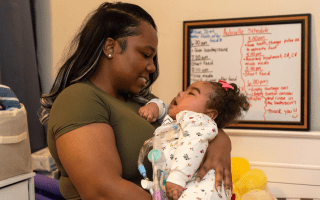
Walking Alongside Families: How Health Home Care Management Changes Lives
Nineteen-month-old Aubrielle is a medically complex child. Born with a rare genetic condition called glycosylation disorder with hypogammaglobulinemia (MOGS 2), as well as an atrial septal defect, her diagnosis is one that only a handful of people in the world share. She requires a tracheostomy, a...
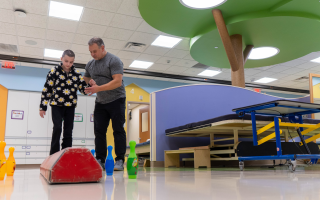
A Christmas Mira-cle: Recovering from an Arteriovenous Malformation
Eleven-year-old Mira was beginning her sixth-grade year when she suddenly became confused and disoriented and then suffered a seizure. She was rushed by ambulance to a nearby emergency room in Norwalk, Connecticut, where a CT scan revealed an arteriovenous malformation, or AVM, a ruptured blood...
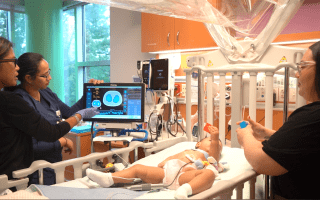
Real-Time Lung Imaging Leads to Life-Changing Breakthrough for Leya
Leya was nearly three-months old when she was admitted to Blythedale Children’s Hospital. Following a brachial plexus injury at birth, her diaphragm was paralyzed and unable to fully expand, impacting her lungs' ability to function properly. After undergoing surgery for a nerve transplant, Leya was...