Born at 24 Weeks: Sofia's Story

Sofia was born in February at 24 weeks' gestation, weighing only 1 lb, 2 oz. The micro-preemie was diagnosed with bronchopulmonary dysplasia and pulmonary hypertension. She was intubated and placed on a ventilator to help her breathe. As she grew, she required both a tracheostomy and a gastrostomy tube.
Once her fragile condition stabilized, Sofia was admitted to Blythedale Children's Hospital for ventilator weaning and comprehensive rehabilitation. She received physical, occupational, speech and feeding therapies to help her meet developmental milestones.
"[In the NICU], they were concerned that she was missing or not reaching her milestones," said Tony, her father. "They told us Blythedale was going to be the best place for her because she was going to be able to move more and because they would train us to prepare her to eventually go home."
Her parents were enrolled in Blythedale's Parent and Family Education Program to learn how to care for their daughter's complicated medical needs.
"Sofia's family needed to learn everything necessary to take a child with complex medical needs home," said Angela Brennan Larkin, MSN, Ed, RN, assistant director of the Parent and Family Education Program. "That included tracheostomy care, ventilator management, feeding tube care, medication management, and emergency preparedness."
Blythedale's Parent and Family Education Program tailors each family's education and training to the child's individual needs, using a multidisciplinary approach so families can feel competent and confident bringing their medically complex child home.
The program also adapted to Tony and Malia's learning styles. For Tony, it was helpful to work in Blythedale's state-of-the-art Simulation Lab and practice procedures and scenarios before performing them at the bedside.
"At first, it was hard for me to even change her diaper," reflected Tony. "One thing that was great here at Blythedale is how comfortable they make you feel and how they do things at your pace."
In the Simulation Lab, clinical educators and respiratory therapists use high-tech medical mannequins to teach caregivers like Tony and Malia how to insert tubes, suction, and monitor and interpret both mechanical signals and their child's physical responses. Following an established multi-tiered training protocol, parents learn everything from bathing a baby with breathing and feeding tubes, to managing portable ventilator and oxygen equipment so they can take a walk outside.

At Blythedale, Sofia finally got to meet her older brother, Gianni.
"Watching the two of them meet each other… our hearts broke; we melted," said Tony. "It was a really special day."
Incorporating Gianni into the training was a crucial step in preparing Sofia to go home. As two working parents, Tony and Malia knew they would need to bring Sofia with them when dropping Gianni off at or picking him up from school. Larkin said working with Tony and Malia was a true partnership.
"As an educator, I may have felt that they needed to get a babysitter or someone to look after Gianni," she said. "But these parents understood that they needed to be able to perform critical caregiving tasks with Gianni in the room to ensure that he understood how to be the sibling of a medically complex child."
"I was truly in awe of them throughout the training," said Larkin.
In November, Sofia was ready to head home with her family, just ahead of the holidays.
"It's bittersweet," reflected Malia. "We have a great team here, and we're going to miss everyone who has had a hand in Sofia's care over the last nine months."

Additional Stories

Clinical Breakthroughs and Comprehensive Rehabilitation Lead to a Childhood of Hope for Aries
At 7 months of age, Aries' mother, Priscilla, noticed that her son was unable to sit up independently. During pediatric check-ups, she was reassured that every child develops differently. However, by his first birthday, Aries was still unable to sit independently and was beginning to show signs of...
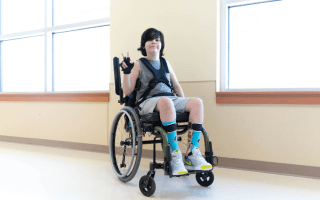
Magnus' Comeback from Transverse Myelitis
On a Friday afternoon in January, 10-year-old Magnus was playing with his younger brothers on a local playground. That evening, he complained of back pain. "By Sunday night, he had lost all mobility," said Pam, his mom. Magnus was rushed to Cohen Children's Medical Center, where he was diagnosed...

From Extreme Prematurity to Remarkable Progress: Alexander's Story
Born at just 24 weeks, Alexander faced extraordinary, life-threatening challenges from his first moments. He required resuscitation at birth and was placed on CPAP, a form of breathing support, in the delivery room. In the NICU, he was diagnosed with chronic lung disease (bronchopulmonary dysplasia)...