Magnus' Comeback from Transverse Myelitis
One child's courageous journey from paralysis to progress shows the power of coordinated pediatric rehabilitation.
On a Friday afternoon in January, 10-year-old Magnus was playing with his younger brothers on a local playground. That evening, he complained of back pain.
"By Sunday night, he had lost all mobility," said Pam, his mom.
Magnus was rushed to Cohen Children's Medical Center, where he was diagnosed with transverse myelitis, a rare neurological disorder in which the spinal cord becomes inflamed, causing pain, muscle weakness, paralysis and more.
"Transverse myelitis is typically an autoimmune condition," said Dennis J. Keselman, MD, attending neurologist at Blythedale Children's Hospital. "A child can get sick with the flu or some other virus, and then about two weeks or even four weeks later, their body has, in a way, made a mistake in their immune system and started attacking itself, as opposed to creating the correct kind of memory for that virus or to fight that virus later. Unfortunately, this type of disorder happens quite commonly in pediatrics and in pediatric neurology and teenagers."
Magnus spent two weeks at Cohen Children's Medical Center, where the team worked aggressively to reduce the inflammation in his spine through different treatments to help prevent further injury. Once his body began responding well to treatment, and he was stabilized, Magnus was ready for the next phase of his recovery. In February, he was admitted to Blythedale Children's Hospital for comprehensive rehabilitation and medication management of his complex condition.
"When we looked into Blythedale, it was the perfect choice," said Pam. "The fact that he can go to school here and continue the intense treatment has been huge. A lot of these other hospitals don't have that option."
Blythedale is the only children's hospital with its own public school district on-site, The Mt. Pleasant Blythedale Union Free School District. Magnus would be able to continue his education while receiving intensive physical and occupational therapy.

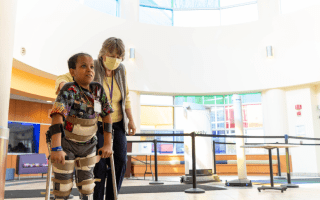
Within Blythedale's Inpatient Hospital, a multidisciplinary team of medical and rehabilitation providers works together to form a treatment plan. Magnus' team included inpatient attending physiatrist Amy Tenaglia, MD. Dr. Tenaglia's role is to lead the team of social workers, therapists, nurses and other physicians to develop a plan to help Magnus reach his rehabilitation potential. Dr. Tenaglia also managed medical issues that came up during his rehabilitation, including prescribing medications to lessen the tightness, or spasticity, in his legs, bracing for his lower extremities, and adaptive equipment like a walker.
"When I first met Magnus, he needed a lot of help. Even moving around in bed required the assistance of another person," said Dr. Tenaglia. As Magnus worked with the team, including Caitlin Reda, PT, DPT, physical therapist, and Bridget Horgan, OTD, OTR/L, occupational therapist, they began to see improvement. By the end of February, he began to regain fine motor function in his arms and fingers, and gross motor function in his left leg.
"Bridget and Caitlin are amazing," said Mike, Magnus' dad. "The amount of work that they put in and the personalization of it; it didn't take them very long to get to know him. They incorporate games and things that he likes to do, like throwing and walking around, trying to kick and playing volleyball. And he's not even realizing that he's doing these things that are hard."
Each day, Magnus continued to make incremental gains.
"Neurologic injury is very unpredictable — what the pathway would be and where someone's function will end up," said Dr. Keselman. "And this is true throughout the nervous system. Transverse myelitis is not a road in which we expect miraculous recovery in a day, but with every step forward comes a massive opportunity for rehabilitation."
Magnus' team worked with his body to reconnect the neurons to signal movement in his spine. It also meant they were able to retrain the brain to bring in other muscles to use the same function.
In June, after four months at Blythedale, Mike walked into Blythedale's Therapy Village to see his son walking with a walker and moving his right leg without Caitlin's assistance.

"It felt like winning the lotto," reflected Pam. "That feeling of if he's going to walk went from that to when he's going to walk."
"He's made such lovely, lovely progress since he's been here," said Dr. Tenaglia. "And it's really been a team and community effort to support him through this. And it has really shown and paid off."
"I hope the other hospitals are like this, but this hospital has just been… we have been welcomed and felt taken care of," said Pam.
A few weeks later, Magnus headed home to Massapequa, where his family was looking forward to Saturday morning pancakes as a family of five again. Magnus will continue his intensive therapies while attending Blythedale's Day Hospital program and continue to make gains.

Additional Stories

Clinical Breakthroughs and Comprehensive Rehabilitation Lead to a Childhood of Hope for Aries
At 7 months of age, Aries' mother, Priscilla, noticed that her son was unable to sit up independently. During pediatric check-ups, she was reassured that every child develops differently. However, by his first birthday, Aries was still unable to sit independently and was beginning to show signs of...

From Extreme Prematurity to Remarkable Progress: Alexander's Story
Born at just 24 weeks, Alexander faced extraordinary, life-threatening challenges from his first moments. He required resuscitation at birth and was placed on CPAP, a form of breathing support, in the delivery room. In the NICU, he was diagnosed with chronic lung disease (bronchopulmonary dysplasia)...
Ten-year-old Anthony was born with spina bifida, a congenital condition that affects his spinal cord, leaving him without sensation or mobility below the lumbar vertebrae and unable to walk independently. Just before his third birthday, Anthony began receiving care at Blythedale Children's Hospital...