Real-Time Lung Imaging Leads to Life-Changing Breakthrough for Leya

Leya was nearly three-months old when she was admitted to Blythedale Children’s Hospital. Following a brachial plexus injury at birth, her diaphragm was paralyzed and unable to fully expand, impacting her lungs' ability to function properly. After undergoing surgery for a nerve transplant, Leya was transferred to Blythedale for ventilator weaning and comprehensive rehabilitation to help determine whether her lungs could gradually expand and strengthen.
When she arrived, she required a tracheostomy and high ventilator settings to support her breathing. For nearly 30 years, Blythedale Children’s Hospital has been a leader in pediatric ventilator weaning. As the only specialty children’s hospital in New York state offering a comprehensive pediatric ventilator-weaning program, Blythedale is uniquely equipped to support patients like Leya.
To guide weaning, the Hospital’s team of pulmonologists, neonatologists and other critical-care trained physicians, and respiratory therapists employed noninvasive technologies, including end-tidal CO₂ monitoring and pulse oximetry, to evaluate Leya's lung function and readiness for reduced support. Using advanced ventilators and monitoring systems, Blythedale continues to push forward innovations in respiratory care. A new tool is now helping drive even better outcomes.
Electrical impedance tomography (EIT), a noninvasive, radiation-free imaging method, allows clinicians to view real-time images of a patient’s lungs and determine the most effective ventilator settings. Blythedale adopted the technology in spring 2023. EIT remains uncommon across U.S. hospitals, and only a small number of children’s hospitals have adopted it in clinical practice, Blythedale being one of them.

“It allows us to see which parts of the lungs are being ventilated,” said Gerald Signorini, MBA, RRT, director of Respiratory Therapy. “Instead of waiting, we’re able to look at the monitor, determine whether our settings are too high, too low, and adjust.”
With EIT, providers can wean patients more precisely and more scientifically.
Leya and her family were told that ventilator weaning might take several years. But with the support of EIT, her care team was able to monitor her lung function closely and adjust her treatment more confidently.
“With EIT, we were able to follow her lung function, and she weaned faster than we thought possible because we had an objective way of knowing,” said Dr. Agnes Banquet, a leading pediatric pulmonologist who works at both Blythedale and Boston Children's Physicians, Westchester Medical Center.
Leya later underwent a plication, a procedure to strengthen her weakened diaphragm so it could better support breathing and allow her lungs to expand more fully. Before surgery, her providers gathered EIT images as a baseline. After the procedure, they compared the scans to determine her optimal ventilator settings.
“Through EIT, we were able to observe how ventilator weaning was helping, how her lungs were expanding, and we could continue to reduce support very carefully,” Dr. Banquet said.
Over time, Leya made steady progress; ultimately weaning off her ventilator support even faster than expected. In September, just two months after her first birthday, she was decannulated. A few days later, she headed home.
“Leya was able to go home probably a year earlier than projected, and without any technology, without a trach and without a vent,” Dr. Banquet said.

Additional Stories

Clinical Breakthroughs and Comprehensive Rehabilitation Lead to a Childhood of Hope for Aries
At 7 months of age, Aries' mother, Priscilla, noticed that her son was unable to sit up independently. During pediatric check-ups, she was reassured that every child develops differently. However, by his first birthday, Aries was still unable to sit independently and was beginning to show signs of...
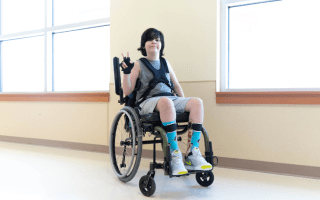
Magnus' Comeback from Transverse Myelitis
On a Friday afternoon in January, 10-year-old Magnus was playing with his younger brothers on a local playground. That evening, he complained of back pain. "By Sunday night, he had lost all mobility," said Pam, his mom. Magnus was rushed to Cohen Children's Medical Center, where he was diagnosed...

From Extreme Prematurity to Remarkable Progress: Alexander's Story
Born at just 24 weeks, Alexander faced extraordinary, life-threatening challenges from his first moments. He required resuscitation at birth and was placed on CPAP, a form of breathing support, in the delivery room. In the NICU, he was diagnosed with chronic lung disease (bronchopulmonary dysplasia)...