Ready to Take his Next Steps
Anthony's Journey to Brooklyn from Blythedale
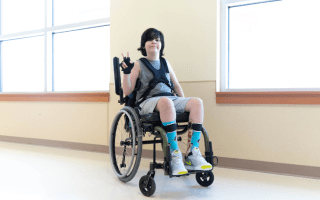
Ten-year-old Anthony was born with spina bifida, a congenital condition that affects his spinal cord, leaving him without sensation or mobility below the lumbar vertebrae and unable to walk independently.

Just before his third birthday, Anthony began receiving care at Blythedale Children's Hospital, enrolling in its Early Childhood Center. There, he was able to learn while also receiving essential comprehensive therapies unavailable in his community, including speech, occupational and physical therapy. Upon graduation from the Early Childhood Center, Anthony began attending the Robert Stone Day Hospital program at Blythedale.
Although Anthony could attend his local school from an academic standpoint, the intensity and frequency of his required therapies were not available in his home district. Blythedale’s Day Hospital program uniquely combines education with medical and therapeutic care.
“There’s really not another school in the New York City area that is able to provide these services at such an intensity for patients with rehabilitative needs,” said Dr. Rebecca Carlin, the Unit Chief of the program. “We enroll patients from Brooklyn, Far Rockaway, Long Island, the Bronx, Manhattan, Westchester, and surrounding counties.”
Dr. Carlin said the program helps younger children build critical life skills.
“We can teach them to use a wheelchair. We can teach them to dress themselves or perform other activities of daily living, or even assist in transfers,” she said. “That’s a huge milestone for some of these children, especially if they can’t put weight on their legs.”
As Anthony grew older, he began using braces for his lower extremities, known as reciprocating gait orthosis, or RGOs, and started learning to walk for the first time.
He worked closely with Linda Fieback, PT, DPT, MA, PCS, director of Physical Therapy at Blythedale, to build those skills.
“With spina bifida, it is very similar to a spinal cord injury,” Fieback said. “We assessed the level of lesions in his spine, which for Anthony are at lumbar vertebrae two and three.”
From there, Fieback evaluated his muscle strength and focused on proper alignment to maximize his ability to walk. When using RGOs, maintaining alignment, with the trunk positioned over the hips and pelvis, allows for more efficient movement.
Research shows children with spina bifida have improved outcomes when they are upright and ambulatory, Fieback said, including benefits to motor development as well as cardiac, respiratory, and digestive health.

During his time at Blythedale, Anthony also formed strong friendships. One of his closest friends is Ashton, another patient who rides the bus with him each day from Brooklyn and also works with Fieback in physical therapy.
“These two were riding the bus together every day, and there was always great conversation,” Fieback said. “They have different challenges, but they share the same goal: they both want to walk.”
Now best friends, the boys support each other in their progress. Last year, they created the “Walking Walkers Club,” where they practice mobility during therapy sessions. The idea began around the time of Ashton’s ninth birthday.
“We talked about how presents don’t always have to be things — they can be presence and time spent together,” Fieback said.
Ashton’s birthday wish reflected that lesson.
“He asked Anthony to walk with him,” she said, “both for his presence and because Anthony can walk a little farther and a little faster.”
After eight years as both a patient and student, Anthony is now preparing to transition back to his community school in Brooklyn.
“The goal of our program is to help children thrive to the point where they can return to their communities,” Carlin said. “It’s bittersweet. Their success outside of here reflects both their hard work and ours.”

Additional Stories

Clinical Breakthroughs and Comprehensive Rehabilitation Lead to a Childhood of Hope for Aries
At 7 months of age, Aries' mother, Priscilla, noticed that her son was unable to sit up independently. During pediatric check-ups, she was reassured that every child develops differently. However, by his first birthday, Aries was still unable to sit independently and was beginning to show signs of...
Magnus' Comeback from Transverse Myelitis
On a Friday afternoon in January, 10-year-old Magnus was playing with his younger brothers on a local playground. That evening, he complained of back pain. "By Sunday night, he had lost all mobility," said Pam, his mom. Magnus was rushed to Cohen Children's Medical Center, where he was diagnosed...

From Extreme Prematurity to Remarkable Progress: Alexander's Story
Born at just 24 weeks, Alexander faced extraordinary, life-threatening challenges from his first moments. He required resuscitation at birth and was placed on CPAP, a form of breathing support, in the delivery room. In the NICU, he was diagnosed with chronic lung disease (bronchopulmonary dysplasia)...